7 Proven Ways to Automate Cardiovascular Imaging Workflows in 2026
Automation and artificial intelligence have reshaped cardiovascular imaging in 2026, transforming how cardiac data is captured, analyzed, and reported. Cardiovascular imaging workflow automation refers to the use of interoperable AI, cloud-based PACS, and integrated reporting systems to streamline every stage of image acquisition, interpretation, and documentation. Across leading centers, automation has improved workflow efficiency by nearly 47%, reduced report turnaround to under five minutes, and lifted diagnostic accuracy to above 91%.
For cardiovascular practices, the opportunity lies in orchestrating these tools into a cohesive digital ecosystem—one that connects imaging modalities, reporting workflows, and EHR systems seamlessly. Market adoption is especially strong in North America, where cloud and AI-driven platforms are now standard for most high-volume clinics.
7 proven automation strategies for 2026
- Cloud PACS automation for cardiology workflows
- AI-assisted segmentation and quantification
- Structured, template-driven reporting
- Unified PACS and CVIS integration
- Vendor-neutral routing and normalization
- Workflow orchestration and smart worklists
- Edge and point-of-care automation for triage

SARC MedIQ Cloud PACS for Cardiovascular Imaging Automation
SARC MedIQ’s cloud PACS exemplifies how modern cardiology practices can automate every stage of imaging—from acquisition to report delivery. Designed for cardiovascular workflows including echo, vascular, cath, CT, and MRI, it combines cloud-native access, AI intelligence, and integration-ready architecture.
By embedding AI-driven orchestration and DICOM-native automation, SARC MedIQ eliminates repetitive manual tasks such as study routing, annotation, and measurement transfer. Built-in regulatory templates ensure compliance with accreditation standards while maintaining diagnostic accuracy. Cardiologists can review echo studies from any device through secure mobile access, sustaining rapid turnaround without compromising security or interoperability.
| Core Functionality | Description |
| AI workflow orchestration | Automates study routing, prioritization, and assignment |
| Mobile remote review | Enables cardiologists to securely review echo and vascular studies on mobile |
| Structured reporting | Auto-populates reports from AI outputs and modality data |
| Registry auto-submission | Submits structured reports directly to STS, ICAVL, or ICAEL |
| Unified imaging timeline | Combines echo, cath, CT, and vascular studies into a single patient view |
AI-Assisted Image Segmentation and Quantification
AI-assisted image segmentation automatically identifies and outlines regions of interest—such as heart chambers—within medical imagery, generating standardized measurements for clinicians. This functionality transforms time-intensive tasks into near-real-time operations.
Deep-learning algorithms now auto-contour cardiac structures, compute ejection fraction and global longitudinal strain, and achieve reproducibility gains of roughly 47%. CNN-driven models have demonstrated echo classification accuracy as high as 97.2%, elevating both precision and consistency.
Platforms such as SARC MedIQ integrate this functionality directly into the imaging workflow, combining quantitative precision with seamless data transfer to structured reports.
| Imaging Modality | Automated Function | Clinical Impact |
| Echocardiography | Chamber contouring and EF calculation | Faster, standardized quantification |
| Cardiac MRI | Volumetric and functional analysis | Improved reproducibility |
| Vascular ultrasound | Plaque segmentation and flow modeling | Enhanced disease tracking |
Structured Template-Driven Reporting with Auto-Population
Structured reporting uses standardized templates with predefined sections and fields, often pre-filled by PACS or AI algorithms. This approach ensures consistent reporting, reduces omissions, and speeds compliance-driven workflows.
Solutions such as SARC MedIQ streamline structured reporting by auto-populating diagnostic data directly from imaging and AI results. This alignment with STS and ICAVL guidelines supports accreditation readiness and minimizes manual input errors.
Automated report generation flow:
- Image capture and AI quantification
- Auto-population of structured template fields
- Clinician validation and sign-off
- Automatic export to EHR or registry
Unified Cardiovascular PACS and CVIS Integration
A Cardiovascular Information System (CVIS) centralizes and manages all cardiovascular imaging and related clinical data across modalities. The power of unifying PACS and CVIS lies in giving clinicians full longitudinal context—combining echocardiograms, cath lab data, ECGs, CTs, and MRIs in a single timeline.
Modern CVIS-integrated platforms, including SARC MedIQ’s unified architecture, enable comparative studies within seconds, simplify data trending, and strengthen interdisciplinary collaboration. For high-volume networks, this unified approach eliminates redundant data storage and reduces review delays, ensuring faster clinical decisions and improved patient continuity.
Benefits include:
- Multi-modality data review in one workspace
- Streamlined integration with EHR and mobile cloud systems
- Reduced manual correlation between prior studies
Vendor-Neutral Routing and Format Normalization
Vendor-neutral routing enables imaging systems to exchange and process data regardless of originating vendor, ensuring full interoperability across diverse setups. The platform automatically converts and distributes imaging files in standard formats such as DICOM and HL7, preserving metadata integrity and ensuring compatibility.
SARC MedIQ supports vendor-neutral data routing and normalization, enabling institutions to consolidate imaging data from multiple systems while maintaining full interoperability for AI analysis and reporting. This flexibility is critical for multi-site workflow alignment and cloud scaling.
Typical routing sequence:
Study ingestion → Normalization → Intelligent routing → AI pipeline → Clinical viewer
Workflow Orchestration and Advanced Worklists
Workflow orchestration automates how imaging studies are prioritized, assigned, and monitored throughout their lifecycle. Advanced digital worklists apply intelligent rules to ensure stat cases rise to the top, exams are routed to the right subspecialists, and flagged anomalies receive immediate review.
SARC MedIQ’s AI-driven orchestrator offers customizable rule sets that streamline operations, reduce bottlenecks, and optimize case flow alongside other major workflow systems.
Impact on operations:
- Reduced turnaround time for urgent studies
- Fewer manual assignments
- Balanced reader workloads
- More predictable resource utilization
EHR Interoperability and Automated Registry Submission
Interoperability is the bi-directional, standards-based exchange of data between PACS, CVIS, and EHR systems—without manual data handling. Seamless integration ensures that finalized reports and measurements appear instantly in patient records, supporting both clinical decision-making and billing accuracy.
SARC MedIQ enables direct registry submission and EHR synchronization from structured cardiovascular reports, ensuring compliance with STS, ICAVL, and ICAEL requirements while maintaining data privacy. Implementations should include patient identity matching, data normalization, and adherence to HIPAA and 21st Century Cures Act standards.
Edge and Point-of-Care Automation for Fast Triage
Point-of-care imaging allows clinicians to perform and interpret diagnostics at the patient’s bedside using portable ultrasound or Doppler tools. In advanced cardiovascular networks, AI-empowered edge devices feed real-time data into enterprise PACS or CVIS environments, triggering automated triage workflows.
With systems such as SARC MedIQ, edge integration allows immediate case inclusion, faster reviewer notification, and measurable reductions in treatment initiation times.
| Workflow Step | Traditional Triage | Edge/POC Automation |
| Study accession | Manual entry, minutes delay | Instant auto-registration |
| Reviewer alert | Manual queue placement | Automated alert via AI worklist |
| Record inclusion | Post-review upload | Real-time EHR synchronization |
Frequently asked questions related Cardiovascular PACS System
How can AI reduce reporting time in cardiovascular imaging workflows?
Which PACS features are essential for cardiovascular imaging centers?
What cloud PACS options support remote mobile review of echo and vascular studies?
How does workflow automation improve throughput in high-volume cardiovascular clinics?
What are key benefits of integrating cardiovascular imaging data with EHR systems?
The Evolution of Cardiac Imaging: How AI, Portability, and Ultra-Resolution Are Transforming Heart Diagnostics
In recent years, cardiac imaging has undergone a remarkable evolution—driven by three converging forces: ultra-high resolution imaging, portable diagnostic devices, and AI-driven insights. Together, these innovations are not just improving image quality—they’re reshaping how, when, and where we diagnose heart conditions.
What was once limited to large hospitals with complex imaging suites is now becoming available in smaller practices, rural settings, and even bedside care. As cardiovascular disease remains a leading cause of mortality worldwide, this evolution is more than technological—it’s lifesaving.
Let’s explore how the next generation of cardiac imaging is being built—and how platforms like SARC MedIQ are making this future accessible to all.
1. From Pixel to Precision: The Rise of Ultra-High Resolution Imaging
Modern modalities such as echocardiography, cardiac MRI, and CT are now capable of visualizing the heart in exquisite detail. But with the emergence of ultra-high resolution imaging, clinicians are spotting subtle changes in cardiac anatomy that were previously undetectable.
These advancements allow for:
- Early identification of atherosclerotic plaque, myocarditis, and early-stage cardiomyopathy
- Better measurement of wall motion abnormalities
- Precise visualization of microvascular obstructions
However, higher resolution imaging comes with higher data volume and complexity. Many clinics struggle to manage this influx due to outdated hardware and limited cloud infrastructure.
How SARC MedIQ Helps
With cloud-native PACS infrastructure, SARC PACS Flow supports high-fidelity imaging without the need for expensive local servers. Clinicians can store, access, and review ultra-resolution studies seamlessly—whether in large hospitals or compact diagnostic centers.
2. Portability Redefined: Imaging at the Point of Care
The traditional cardiac imaging model—patients scheduled in hospital imaging suites—often results in long wait times and diagnostic delays. Enter portable echocardiography and handheld ultrasound devices. These compact tools empower clinicians to perform rapid cardiac assessments at the bedside, in emergency rooms, or during home visits.
Benefits of portable imaging include:
- Faster diagnosis in acute cases like heart failure
- Increased access in remote or underserved areas
- Real-time cardiac monitoring during treatment plans
Yet, these tools are only as effective as the systems behind them. Image quality, storage, and reporting workflows still need to be streamlined.
How SARC MedIQ Helps
SARC MedIQ offers device-agnostic imaging access, mobile compatibility, and ShareSecure—a HIPAA-compliant link-based sharing feature that lets clinicians review and distribute portable studies in seconds. No CDs, no login barriers. Just secure, point-of-care cardiology.
3. Intelligence at the Core: AI-Powered Cardiac Imaging Workflows
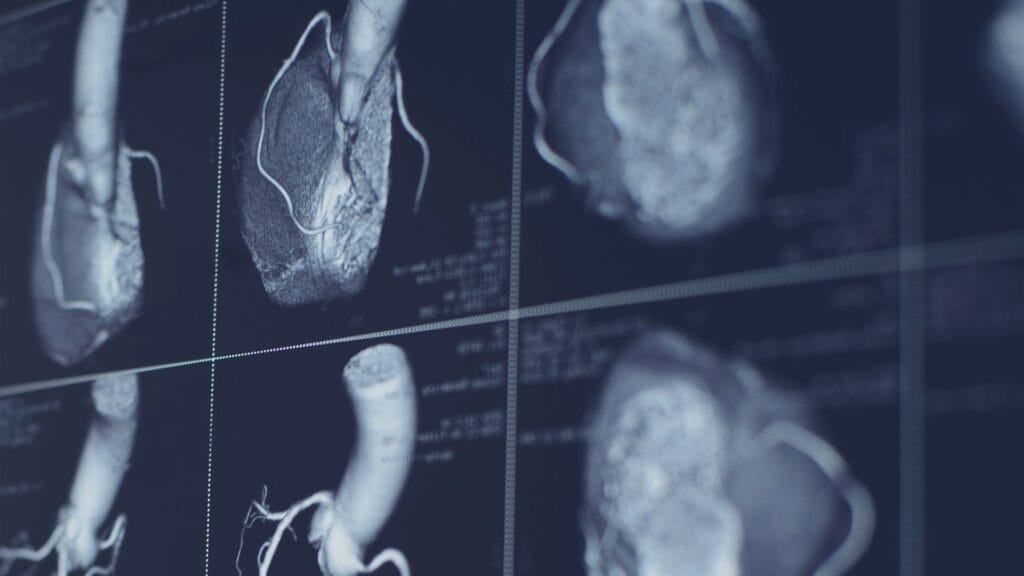
AI is no longer a futuristic idea—it’s actively transforming how clinicians interpret cardiac images. From identifying anomalies to pre-generating structured reports, AI is the new backbone of imaging efficiency.
Emerging AI models now assist with:
- Recognizing wall motion abnormalities
- Detecting cardiomegaly, valve dysfunction, or chamber enlargement
- Automating quantifications in echocardiography
But for AI to perform effectively, imaging data must be standardized, structured, and clean—a major challenge for practices still relying on legacy systems or manual documentation.
How SARC MedIQ Helps
SARC’s AIReports platform enhances clinical decision-making with AI-assisted findings, automated annotations, and structured reporting.
4. Infrastructure Still Matters: Cloud Is the Catalyst
Even the most advanced tools are only as powerful as the system supporting them. For AI, portability, and ultra-resolution to work seamlessly, healthcare organizations must invest in interoperable, cloud-based ecosystems.
Challenges with legacy systems include:
- Limited scalability for imaging volume
- Compatibility issues with new AI models
- Repetitive logins across PACS, EMR, and viewers
How SARC MedIQ Helps
As a all-in-one imaging platform, SARC MedIQ provides:
- Single sign-on access across tools and integrations
- End-to-end workflow support for acquisition, viewing, reporting, and sharing
- Full customization under your brand, without needing internal tech teams
The Future Is Already Here — But Only If You’re Ready
The evolution of cardiac imaging isn’t on the horizon—it’s happening right now. Portable devices, AI-assisted reporting, and ultra-resolution imaging are changing not just the how, but the who and where of cardiac care.
Clinicians no longer need to be tied to large institutions or complex setups to deliver high-quality diagnostics. With platforms like SARC MedIQ, modern cardiac imaging becomes accessible, scalable, and efficient—even for small practices and teleradiology groups.
How SARC MedIQ CPACS is improving Bottom line of Cardiology Practices.
Cardiology facilities, regardless of size, struggle with time-consuming manual tasks, such as managing patient study requests. For instance, burning CDs for patient studies is just one example of the many labor-intensive processes that divert staff from direct patient care. This not only hampers efficiency but also risks non-compliance with the 21st Century Cures Act . Facilities relying on outdated practices may face significant penalties from authorities, as these methods fall short of the Act’s requirements for timely patient access to electronic health information and data portability.
SARC MedIQ, a leader in Cardiology PACS solutions, is transforming how cardiology facilities operate, allowing professionals to do more in less time. Here are some notable features of our CPACS :
1. Seamless Integration with Existing EMRs and EHRs
SARC MedIQ Cardiology PACS system is built to integrate seamlessly with nearly all existing EMR and EHR systems on the market. This compatibility ensures that cardiologists have immediate access to critical patient data, eliminating the need for manual data transfers and reducing the risk of errors. With this level of integration, you can streamline your workflow and focus on delivering high-quality care, confident that all essential information is at your fingertips.
2. AI-Powered Report Generation in Under 2 Minutes
Our proprietary AI technology revolutionizes the report generation process, drastically cutting down the time required to create detailed patient reports. By automatically filling out pre-templated findings, our system allows cardiologists to bypass the tedious manual entry process, providing the option to make edits if needed. This not only increases efficiency but also reduces the cognitive load on your team, allowing them to dedicate more time to patient care and other critical tasks.
3. Secure Medical Study Transfers via 2FA Cloud Link
With SARC MedIQ, the hectic process of burning CD’s for study transfers is a thing of the past. Our platform allows you to securely share patient studies with just one click via a 2FA-protected cloud link. Patients can access their studies from anywhere, on any device, without the need to download or install large resources. This secure method ensures compliance with privacy regulations while offering fast, efficient, and seamless access to sensitive patient data, giving peace of mind to both staff and patients.
4. Legacy Study Storage Solutions
For cardiology facilities managing a large volume of legacy studies, SARC MedIQ offers a secure and efficient cloud storage solution. Our platform ensures that past patient studies are safely stored in the cloud, making them easily retrievable whenever needed. This service not only frees up physical storage space but also ensures that valuable historical data is preserved and can be accessed quickly, enhancing the overall efficiency and continuity of patient care.
5. Get Compliant with Confidence
SARC MedIQ is built on a secure, FDA, HIPAA, and HL7 compliant infrastructure, ensuring your facility meets the strictest standards. Our CPACS is aligned with the regulatory requirements of the 21st Century Cures Act, helping your facility stay compliant and avoid costly penalties. With SARC MedIQ, you can focus on patient care while we ensure your systems are up to code.
In today’s fast-paced healthcare environment, efficiency and compliance are paramount, especially in cardiology facilities where every second counts. SARC MedIQ offers a comprehensive suite of solutions designed to streamline your workflow, enhance patient care, and ensure compliance with industry regulations. From seamless EMR integration to AI-powered report generation and secure, cloud-based data sharing, SARC MedIQ empowers your facility to operate at its best. Ready to experience the difference? Request a Demo today and see how SARC MedIQ can transform your practice.